
How Idaho Busted Mugshots Are Made
A booking photo gets made during county-jail intake. Idaho Code §20-601 puts county jails under the sheriff. Anyone taken to jail must be booked, photographed, and fingerprinted. That is the intake step the law covers. It does not order counties to post images online. A sheriff might run a searchable roster, publish a feed, offer a text or PDF report, or route requests to the records unit.
The photo and the public webpage are separate records. Some systems display an image only while a person is in custody. Others list recent arrests for a short window. Many rural counties have no public photo page at all. After release, a person can drop off a current roster even though the booking record stays with the agency.
The Legislature's page posts the full text of Idaho Code §20-601. Reading it shows the booking duties that apply the moment a person enters a county jail.
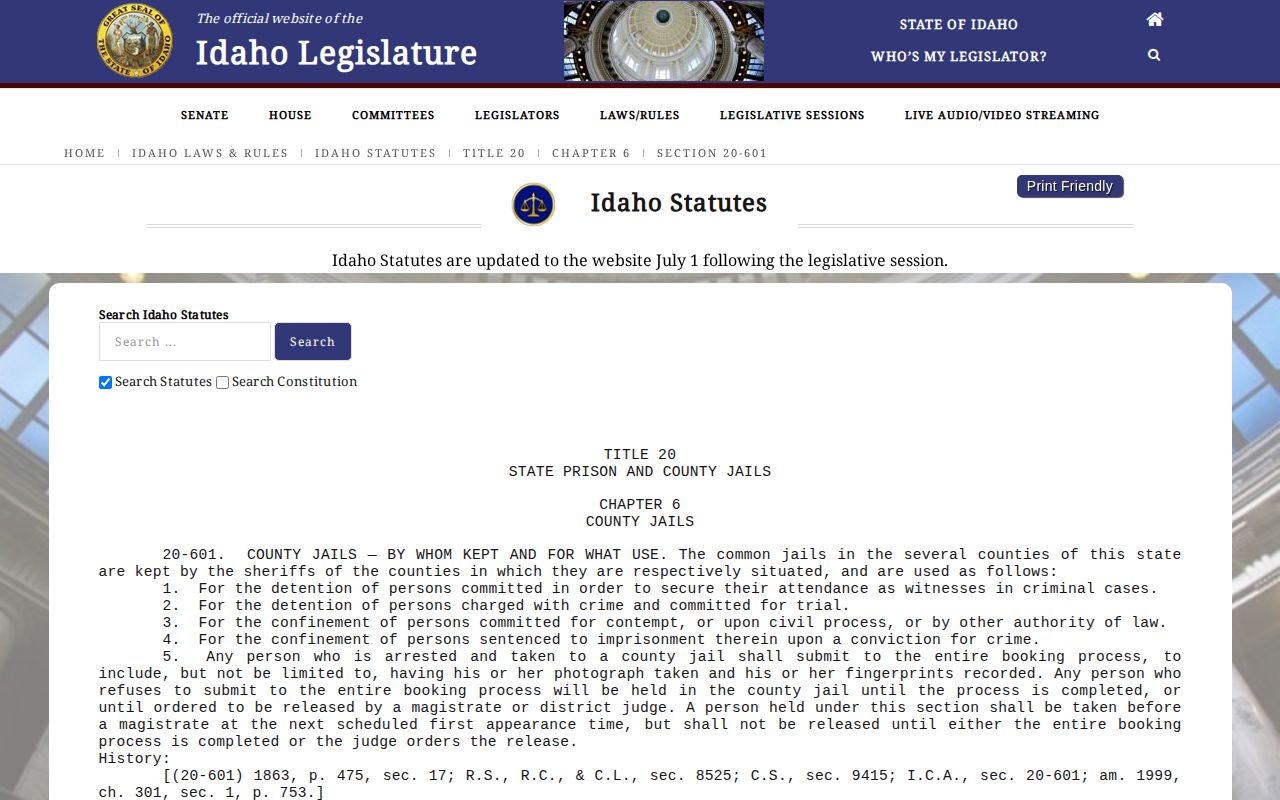
Online publication is a local choice. That is why a booking image can exist even when no county website shows one.
The court file is the place to look for the disposition. A dismissal, acquittal, plea, or judgment all appears there.
Fields in an Idaho Booking Record
Idaho has no single statewide booking form, and each county shapes its own record. A public roster may show fewer fields than the file the sheriff actually holds. The Idaho Public Records Act defines the arrest facts open to the public. That list covers a person's name, sex, age, and address. It also covers the time, date, and place of the incident and the arrest. The crime charged is on the list too, subject to other law and stated exceptions.
A booking photo and fingerprints come from the intake process. Even so, the public interface may skip the image. Courts, state supervision, and federal custody keep separate records. Each has its own custodian and its own fields. The table describes details a requester can ask a custodian to locate. It is not a promise about every roster. Ask the right office for the right record.
| Record field | What it can show |
|---|---|
| Person details | Name, sex, age, and address when releasable under the public-records law. |
| Arrest event | Time, date, and place of the incident and arrest, plus the arresting agency when listed. |
| Charge | The crime charged at arrest. It may differ from a later filed charge or court outcome. |
| Booking material | A county-jail photograph and fingerprints are created during booking, though online display varies. |
| Required paperwork | Documents that the law requires to be given to the arrested person, with statutory exceptions. |
| State court case | Filed charges, hearings, motions, pleas, judgment, and disposition in iCourt or the clerk’s file. |
A blank field proves nothing. The record may sit in a separate agency file, fall under an exemption, or come only by request. Other material needs special care. Juvenile files, active investigative details, victim information, medical data, and protected security material may be withheld or redacted.
Request Idaho Booking Records
A live roster may lack a name or an image. Then call the office that holds the record. Go to the source. City police keep the incident report. The sheriff or jail keeps booking material. State criminal history sits with the Idaho State Police Bureau of Criminal Identification. IDOC status records belong to the Department of Correction. A narrow request beats asking for every arrest and photo.
Idaho Code Title 74, Chapter 1 governs these requests. Attorney General guidance gives residents up to ten working days for a response. Nonresidents can wait up to thirty-five days, subject to lawful extensions. Residents get two free hours of processing. The first one hundred pages are free as well; further charges follow the statutory formula. A county can set its own form, delivery method, or media fee. The Idaho Attorney General public-records page outlines the request elements and the state framework. Start with these steps:
- Identify the arresting agency and the county jail that booked the person. If the person may be held elsewhere, name the receiving county too.
- Give the person’s full name and the arrest or booking date range. Add an agency, booking number, or court case number if known.
- Ask for the specific item, such as the booking record, booking photo, arrest report, or public disposition documents. Ask the custodian to cite any basis for a denial or redaction.
- For an IDOC record, use the Department’s records request portal. For a court file, search iCourt or ask the clerk. These requests do not replace one another.
The Attorney General's page carries the request guidance. Its Public Records Law Manual explains the access presumption, agency response duties, fees, and exemptions. Name the exact record and custodian. A broad request takes longer to search, and an agency can withhold material protected by a statute or court rule.
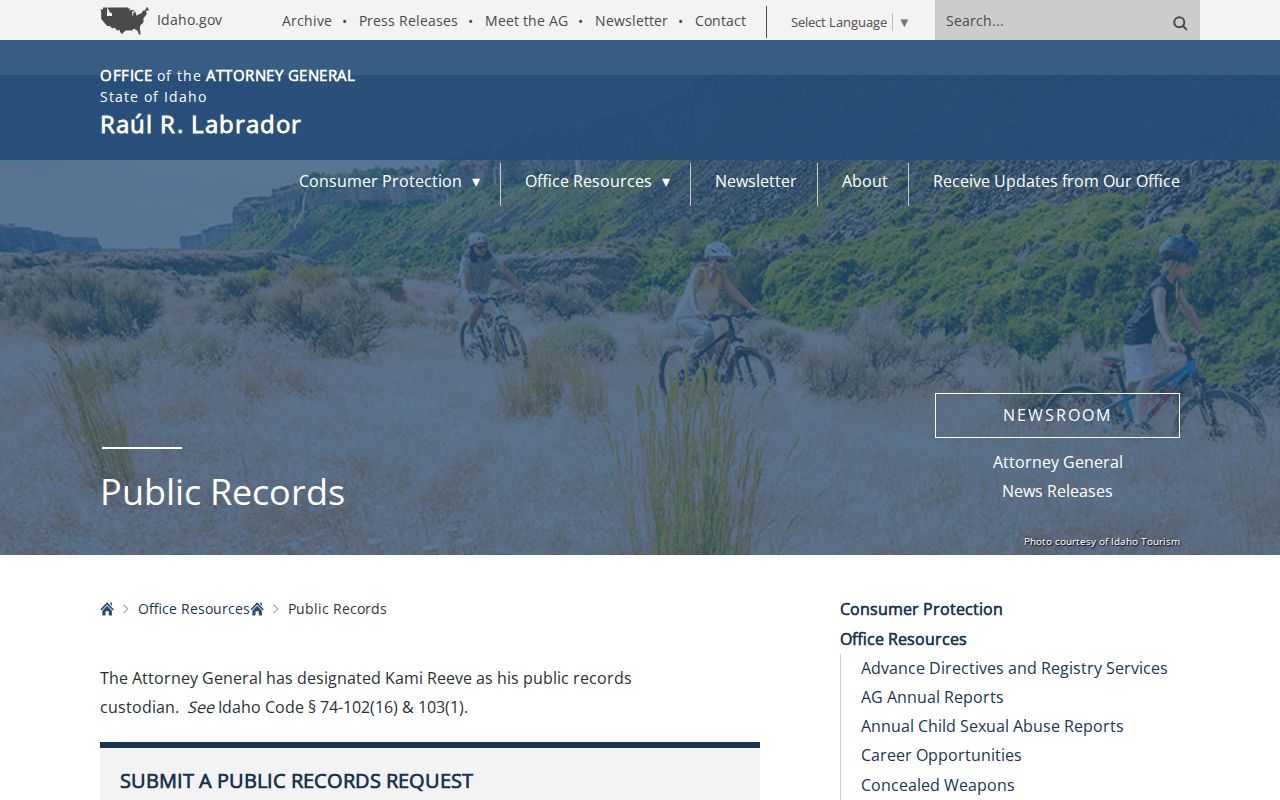
The Attorney General's page is statewide guidance. Each sheriff or city office sets its own submission route, so find the right county before sending a booking request.
Idaho Law on Busted Mugshots
A photograph is baked into Idaho's booking process at the county level. What the state has never done is pass a blanket rule ordering every image online. The Idaho Public Records Act leans toward access. At the same time, Sections 74-105 and 74-124 shield juvenile records and certain investigative material. So each record gets its own call. Nobody can promise that every field or photo will appear on a roster.
The Legislature took a run at the question with H.B. 620 in 2022. That bill targeted a narrow group: people booked only for certain misdemeanors and then held for mental-health care. It cleared the House. The Senate said no. Its limits never became law, and Idaho today has no statute forcing free removal of booking photos from websites or banning all private publication.
Silence on publication cuts both ways. A copy can still be wrong. A record can still be closed. Courts seal cases, juvenile protections hold, and agencies may redact material covered by an exemption. The Idaho Supreme Court's ruling in State v. Alwin dealt with a booking-style photo as evidence, not with any general right to publish images online.
Idaho Code §20-601 lists a photograph among the required booking steps. Web posting statewide is another matter. The statute simply does not demand it. So a missing online image proves nothing about whether a booking photo exists at all.
When Idaho Records Are Shielded
Idaho gives people two separate paths to relief. One sits in Idaho Code §67-3004(10). Under it, a person can ask Idaho State Police to expunge the fingerprint and criminal-history record tied to an incident. Eligibility hinges on a few conditions. No charging instrument may have been filed within a year. Or every charge ended in acquittal or dismissal, subject to the withheld-judgment exception. The request goes to the state criminal-history repository with agency or court proof of eligibility.
The Clean Slate Act, §67-3004(11), works differently. An eligible person may petition to shield a qualifying nonviolent, non-assaultive offense or incident. The window opens five years after finishing the sentence and all ordered conditions. One petition covers one offense or one set tied to a single incident. Each person gets one winning petition in a lifetime. Shielding blocks public access; it does not destroy the case file.
Neither route wipes a county booking image or a third-party copy on its own. Removal can mean separate outreach to Idaho State Police, the court, and the county record holder. The publisher and a search engine may need their own contact. An official page can change while the search result lingers. Google's outdated-content tool can refresh the index. That step still erases no agency file or private archive.
For the fingerprint-record process, the Idaho State Police BCI page lays out the details. The Idaho Supreme Court Clean Slate Act page carries the current petition instructions and forms.
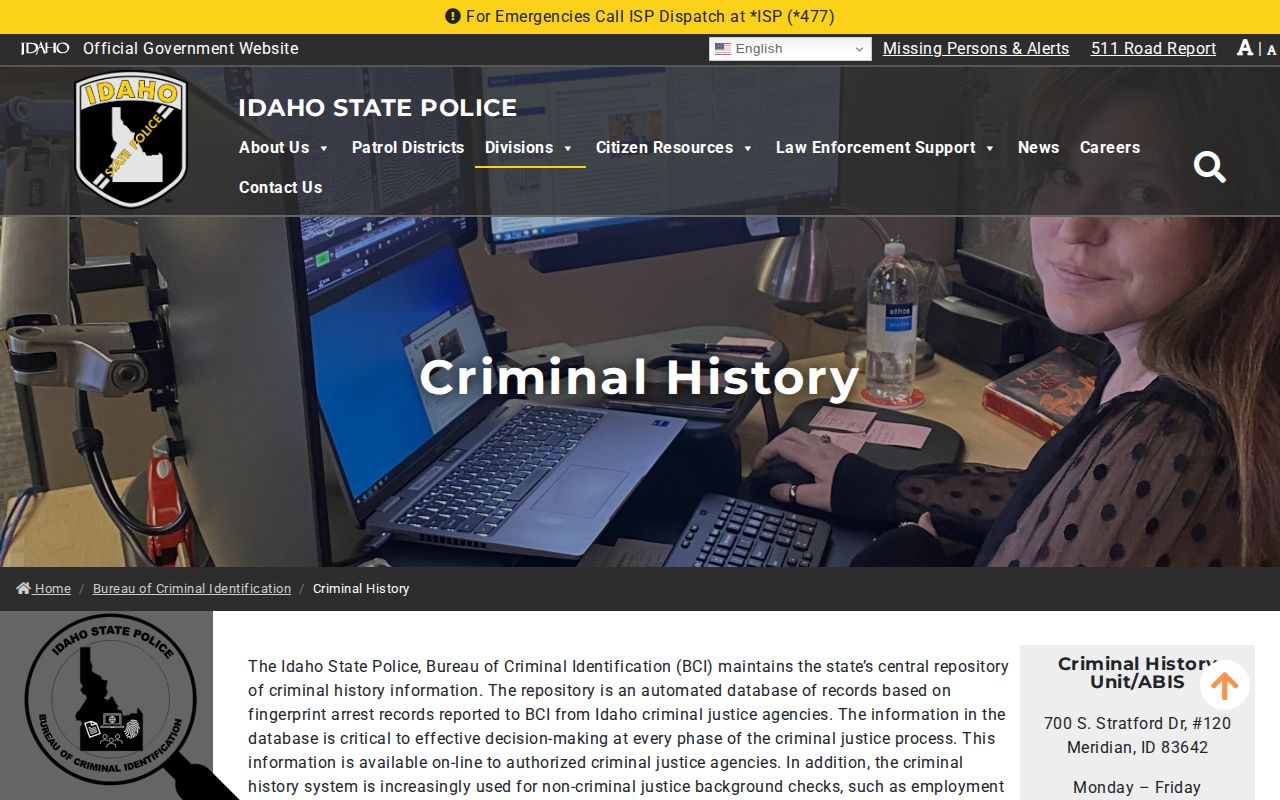
State-history relief reaches the repository's own record. It cannot order a county or a publisher to erase a copy. The court route runs separately from the State Police process. The Idaho Supreme Court's Clean Slate page posts the petition steps. It also supplies the forms for qualifying shielding requests.
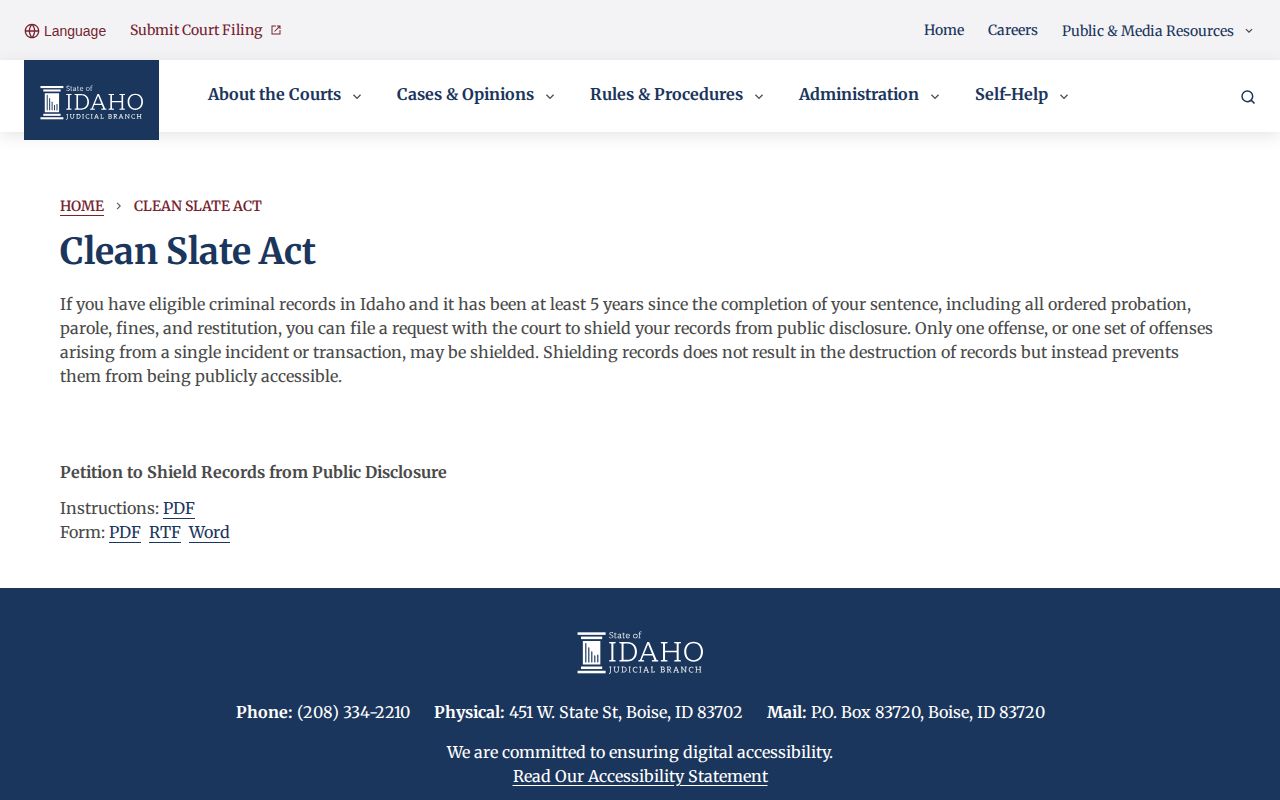
Per the court's explanation, shielding blocks public access once a qualifying order issues. Authorized courts and justice officials still retain access.
Find Idaho Busted Mugshots by County
No single Idaho booking-photo database exists. Start by placing the arrest. City police often make the bust. Booking, though, may happen in a county jail or a receiving county working under contract. That split matters. The arresting agency and the jail can hold different records. The Idaho County Directory leads to each county site, with its own roster, feed, app, or records-request instructions. When custody is unclear, work through that order.
- Search the arresting county’s current roster or recent-arrest feed. Look for a custody label and posting date, not only a charge.
- If no record appears, check whether the person was booked in a neighboring or contract jail. Teton County’s inmates, for example, are housed at Madison County Jail under the arrangement reported in the county research.
- Ask the sheriff or police records unit for a retained booking record or image if the public interface has no photo, has expired, or does not cover the event.
- If the person is serving a state sentence or is on probation or parole, use the IDOC Resident/Client Search. It is not a county jail roster.
- For the filed charge, hearings, judgment, or disposition, use iCourt and the clerk’s record. A roster does not show the full case history.
Not every arrest ends in a county jail. Some people land in federal custody, and others are held on immigration holds. Each of those tracks uses a separate search. So an empty county result proves nothing. Spelling slips, data delays, court sealing, a transfer between facilities, or a short feed window can all hide a booking record that exists.
For state custody, the official IDOC Resident/Client Search covers people under state jurisdiction or supervision. It posts no public offender photo. It also skips most Idaho arrests. The Bannock County roster page points visitors to the sheriff's app for its current jail roster, though it promises neither a photo field nor a fixed retention period.
Where Idaho County Rosters Show Photos
County systems differ in what they show and how long an entry stays online. In the August 2026 audit, six systems showed booking images: Ada, Blaine, Bonneville, Canyon, the joint Cassia and Minidoka system, and Power. This is an observation of the public interfaces, not a statewide posting duty. A roster photo can be missing because the county does not publish it, the person is outside the custody window, the image is withheld, or the file requires a records request.
| Public system pattern | Examples from the audit | What the visitor should expect |
|---|---|---|
| Photo-bearing web roster or feed | Ada, Blaine, Bonneville, Canyon, Cassia/Minidoka, Power | Search and fields vary; the photo may be tied to current custody or a short arrest window. |
| Text or PDF roster | Kootenai, Twin Falls, Bonner, Nez Perce | Booking, release, agency, bond, offense, or status details can appear without an image. |
| App route | Bannock; Idaho Sheriff Connect in several counties | The app can carry inmate search, alerts, or jail information; its existence does not prove a photo field. |
| No verified public roster | Many rural counties in the review | Contact the sheriff or use the county public-records route. An absence online is not an absence of records. |
The Canyon County Jail Roster lets you search by name, and it carries a caution of its own. A charge shown on the roster may differ from what the prosecutor files or what a court finally decides. The Kootenai County in-custody report is a good example of a plain text and PDF listing. Twin Falls takes another route, posting dated arrest and release reports with no photo column. For a direct lookup, the Canyon County Jail Roster search page is the official interface to use.
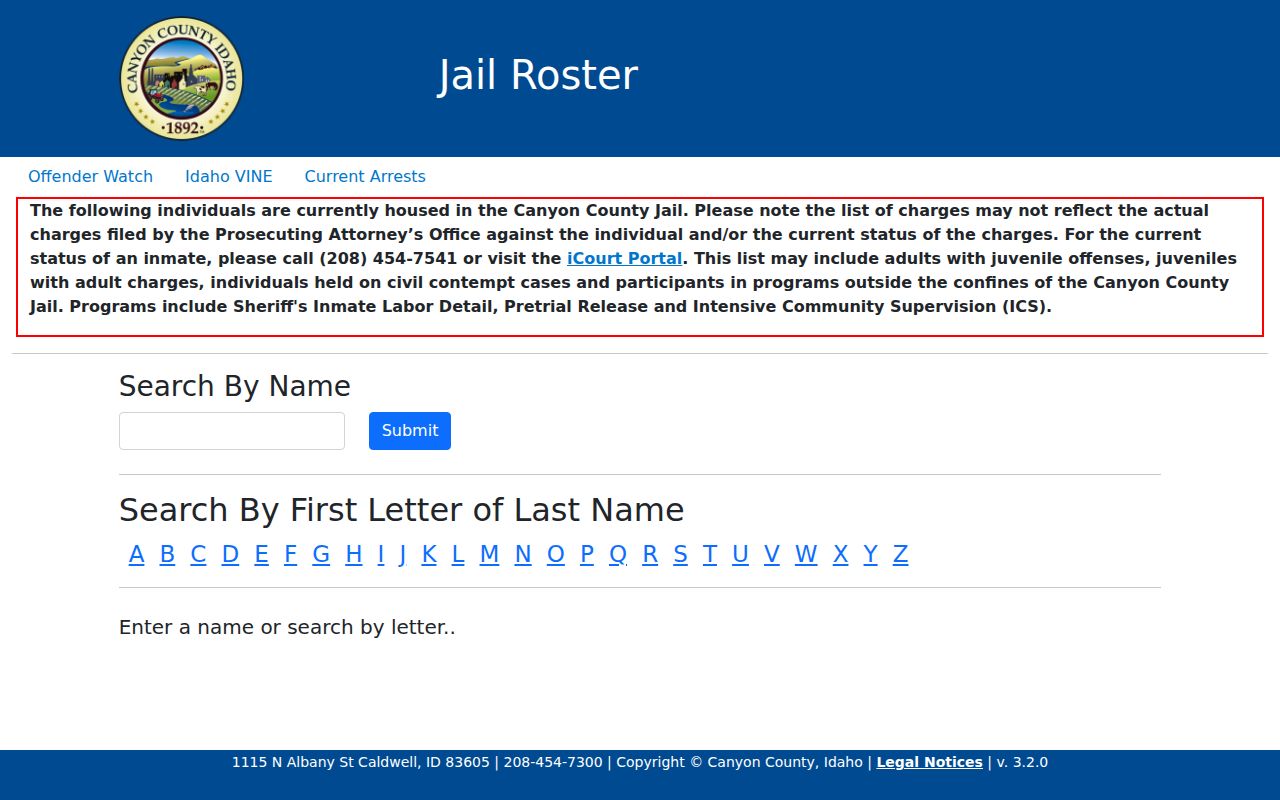
A name-search entry point does not turn the statewide resource into a gallery of faces. The Blaine County recent-arrests page works the same way, covering a rolling date window without showing individuals.
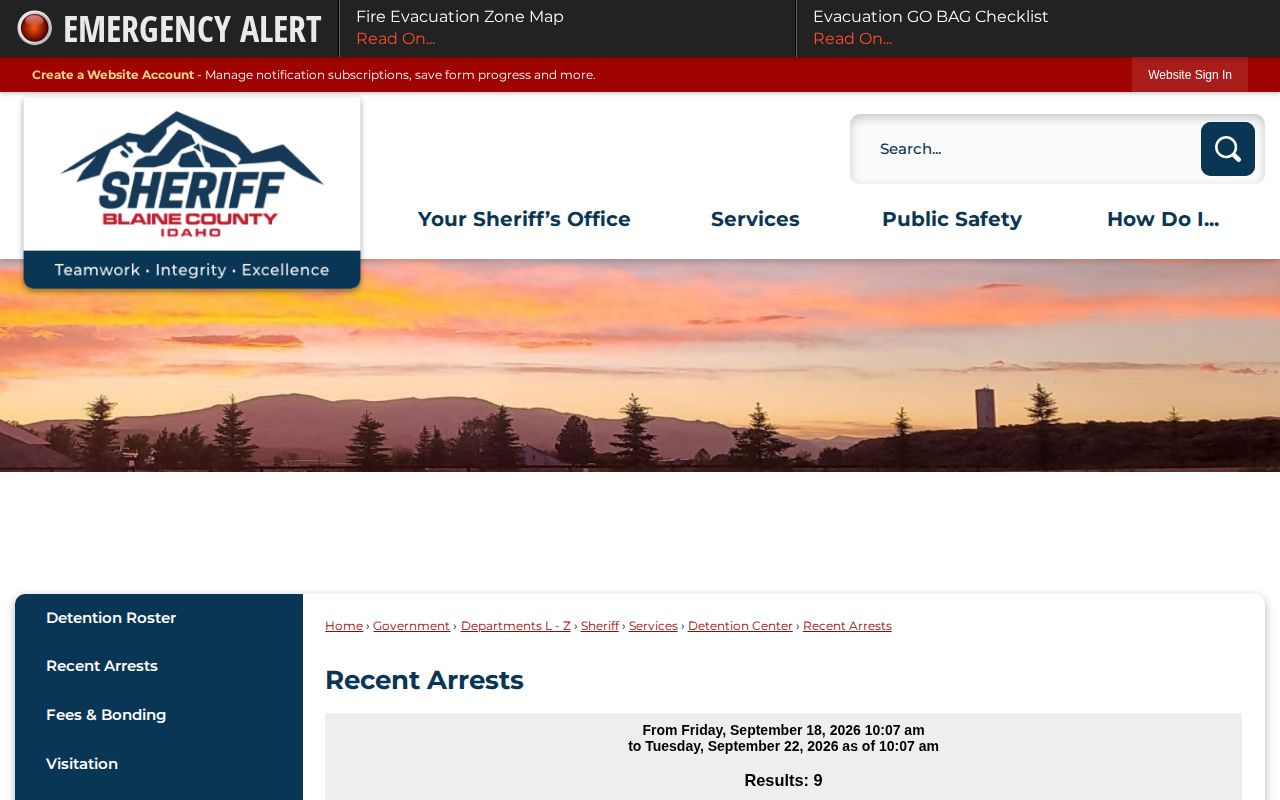
Blaine's recent-arrest view spans roughly four days. For current detention lookup, the county maintains a separate roster.
Idaho Feed and App Busted Updates
Rosters and feeds answer different questions. A roster tracks people held right now. A recent-arrest feed can list people already released within a short rolling window. Ada County's current-arrest screen offers 24-hour, four-hour, and five-day views. Blaine's feed spans about four days. Canyon's August 13–18, 2026 view was a dated snapshot, not a guaranteed archive.
Weekends and transfers make feeds uneven. An arrest happens before the receiving jail finishes intake or updates its public page. Someone may be released before the next roster refresh. If a feed lacks an older date range, ask the agency whether it keeps a separate booking log or records archive.
Apps play varied roles. Bannock's county page points to its official app for roster access. Bonneville, Canyon, Benewah, and Elmore all have documented Idaho Sheriff Connect paths for jail information or alerts. Bonner has promoted the same app, though the store description does not promise photo access. Check the county's own page for supported features.
Idaho VINE can send custody-change alerts where a facility participates. It is an alert service, not a roster. ISP's alerts concern safety and missing persons, not arrests. Notifications help a person follow custody status. Still, the originating jail remains the source for a booking record.
The Ada County Current Arrests page shows how one county offers several time filters through a single official interface.
Idaho Busted Mugshots and IDOC Status
The Idaho Department of Correction search covers everyone under state jurisdiction: incarcerated people, probationers, and parolees. It is a text and status locator. Results show names, IDOC numbers, birth years, and status fields. No photo field appears in results or profiles. The agency describes no public photo-update policy.
People who finished a sentence can still be searched by name, though the IDOC page says their convictions do not appear. A discharged result proves neither custody nor a new arrest. IDOC updates records daily, yet the latest location, status, or termination date may lag. For an IDOC-held record that is not on screen, use the Department's Request for Information form or records portal.
The official Resident/Client Search requires a last name or IDOC number. Partial last names need at least two characters. Partial numbers need three digits. The first name is optional.
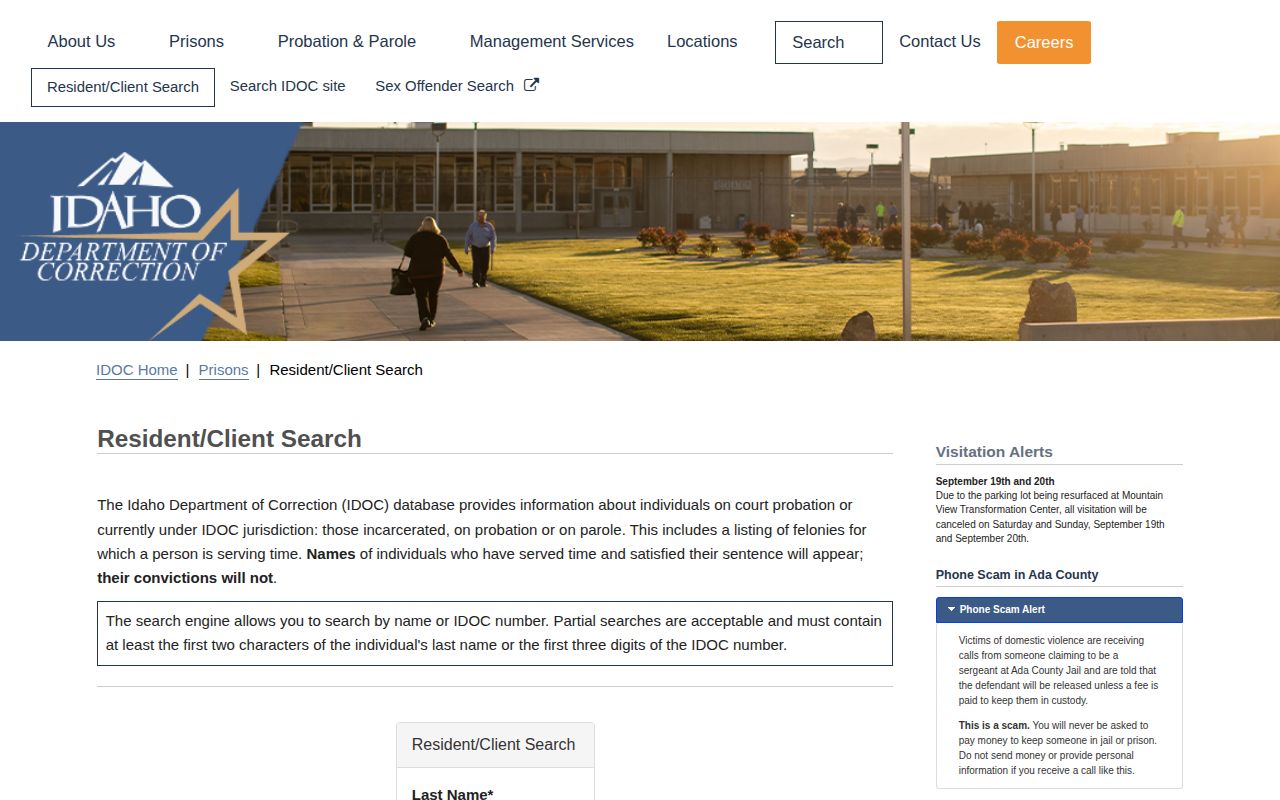
The form helps find state custody or supervision records. A county booking photo must come from the agency that made or holds it.
Idaho Court Records and Warrants
Idaho iCourt tracks a case after booking. Public case information can show the complaint or information, hearings, amended charges, pleas, judgments, sentences, dismissals, and other dispositions. During county transitions, the portal may need to be paired with the older Repository. For a certified file, ask the clerk. A courthouse kiosk works too.
Warrant searches have real limits. Bench warrants are generally public. Unreturned arrest and search warrants can stay sealed or restricted until served, and portal access also depends on case status and warrant type. A clear name search is not a universal warrant clearance. A jail roster is not a warrant list either. Anyone who believes a warrant concerns them should contact a lawyer or the court, not approach an officer or dodge service.
The Idaho iCourt Portal is the statewide case-search route. The court's warrant tutorial explains the difference between bench, sealed, and unreturned warrants. It is a search aid, though, not a promise that every warrant is public.
Idaho Federal Custody Uses Other Searches
A county jail roster sometimes flags a federal hold. The federal case file stays elsewhere. For people serving federal sentences, the Federal Bureau of Prisons locator searches by name or register number. It shows location and status only. No public booking photo appears there. Someone held in federal pretrial custody may sit in a contract county facility under the U.S. Marshals Service long before any BOP sentence exists.
Immigration detention works differently. ICE's Online Detainee Locator finds current detainees with an A-number or basic biographical details, within the locator's coverage limits. It is not an Idaho arrest roster. It offers no public photo field either. People can shift between a county facility and federal custody, which is why the hold label and the holding agency matter. For federal court filings, use PACER or the U.S. District Court for Idaho's case-information route.
Use the BOP Inmate Locator for federal prison custody and the ICE Online Detainee Locator for the covered immigration custody search; a hit in either system never replaces a county booking record or a court disposition.
Older Idaho Mugshots in Archives
For old state-prison records, the Old Idaho Penitentiary files are the strongest lead. The prison closed in December 1973. It had operated since 1872. Idaho State Archives materials may hold mug shots, description forms, parole papers, and other records. A digitized index covers penitentiary inmates from roughly 1864 through 1947. Not every file or photograph survives online.
A county event needs a different route. Start with the sheriff or police custodian, then ask the court clerk about the case. If records were transferred, or the event predates ordinary retention, ask the Idaho State Archives for a finding-aid search. The archives collection is not a statewide booking database. The Old Mugshots archive route details the record eras and request steps, and the Old Idaho Penitentiary FAQ describes the resident files and photographs; a catalog miss does not prove a record was destroyed.
Idaho Busted Mugshots on Other Sites
Commercial mugshot indexes and news pages are copies or selected reports, not Idaho government rosters. Gaps are common. A site may skip whole counties. It can show a booking photo after release, name the wrong agency, or keep a stale charge. Check the official sheriff, jail, police, or court source first. Nothing on a secondary site proves a current booking.
The commercial services in this space include Busted Newspaper Idaho, RecentlyBooked Idaho, Mugshots.com Idaho, Arrests.org Idaho, and Mugshots Zone. Each works a bit differently. RecentlyBooked groups entries by county over a recent window, but its state listing has county gaps. Mugshots Zone lists no clear Idaho index. Arrests.org posts no clear free removal path for records.
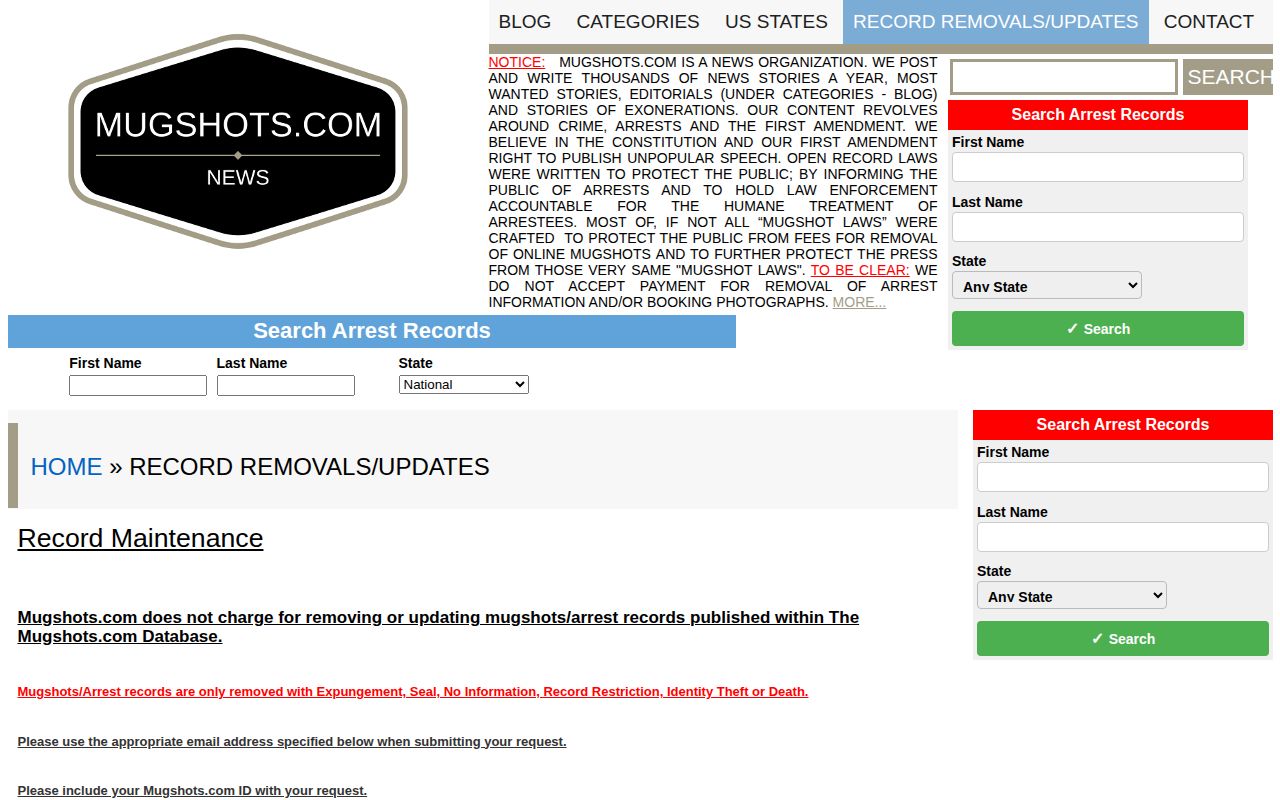
Some publishers offer free corrections when supported by a dismissal, acquittal, seal, or identity fix. Busted Newspaper wants the exact listing plus legal documents. RecentlyBooked asks for the record URL and a reason. Mugshots.com advertises free updates and record maintenance. These are voluntary publisher policies rather than an Idaho legal right. They never touch the agency or court record. Fix the official record first, follow the publisher's own current instructions, and never pay a stranger who promises to erase every copy.
Note: the Mugshots.com Record Maintenance page describes its free update process, a publisher statement rather than an Idaho agency rule.
Winning in court can support a publisher correction. It still will not scrub the record from every index or search result. News outlets pick stories rather than run full rosters. The Idaho Statesman covers Treasure Valley and statewide cases. KTVB and KIVI handle regional and statewide crime news. East Idaho News and Local News 8 cover the east, while KMVT serves south-central Idaho. The Idaho State Journal, Coeur d'Alene Press, Bonner County Daily Bee, and Idaho Mountain Express each track their own regional records and court news.
Photos vary by story. A piece may carry an agency booking photo, a file image, a scene photo, or a courtroom shot. Read the caption. Follow the case to its court disposition. No news report replaces the agency record; send corrections to the outlet and rely on the court or agency for the official outcome.
Idaho Busted Mugshots: Choose the County
City arrests often cross county lines. The arresting police department and the receiving jail are separate agencies. The city report documents the stop or arrest. The jail record covers intake and custody. So pick the county holding the person first. Then use that sheriff or jail's roster, feed, app, or request process. The County Directory lists every Idaho county site alphabetically and names each county seat.
If the name is missing, ask the arresting agency where the booking happened and whether the record is public. State custody means IDOC. A filed criminal case belongs in the court record. Arrest, booking, custody, sentence, and court result answer different questions, so keep them separate.