
Where Idaho Mugshot Archives Begin
Every search starts with one question. Who made the record? Someone can be arrested in one Idaho county, booked in a second under a contract arrangement, and later held in state prison. Contact the county or city agency that handled the arrest first. Idaho law treats a jail photograph as part of the booking event. Even so, no statewide photo archive gathers every county image in one place.
The Idaho State Archives works differently. It keeps penitentiary material, historic photographs, newspapers, sheriff and police records, and county court records that were transferred or microfilmed. The catalog skips plenty. Much of it sits in paper only. Ask the staff about finding aids and uncataloged groups before giving up on a file.
Its Old Idaho Penitentiary page describes resident files. Those files may hold mug shots, description forms, pardon and parole papers, and punishment notes. The historic penitentiary page displays collection details, not an individual booking photograph. Use it to name the collection. Then search the finding aids for a name.
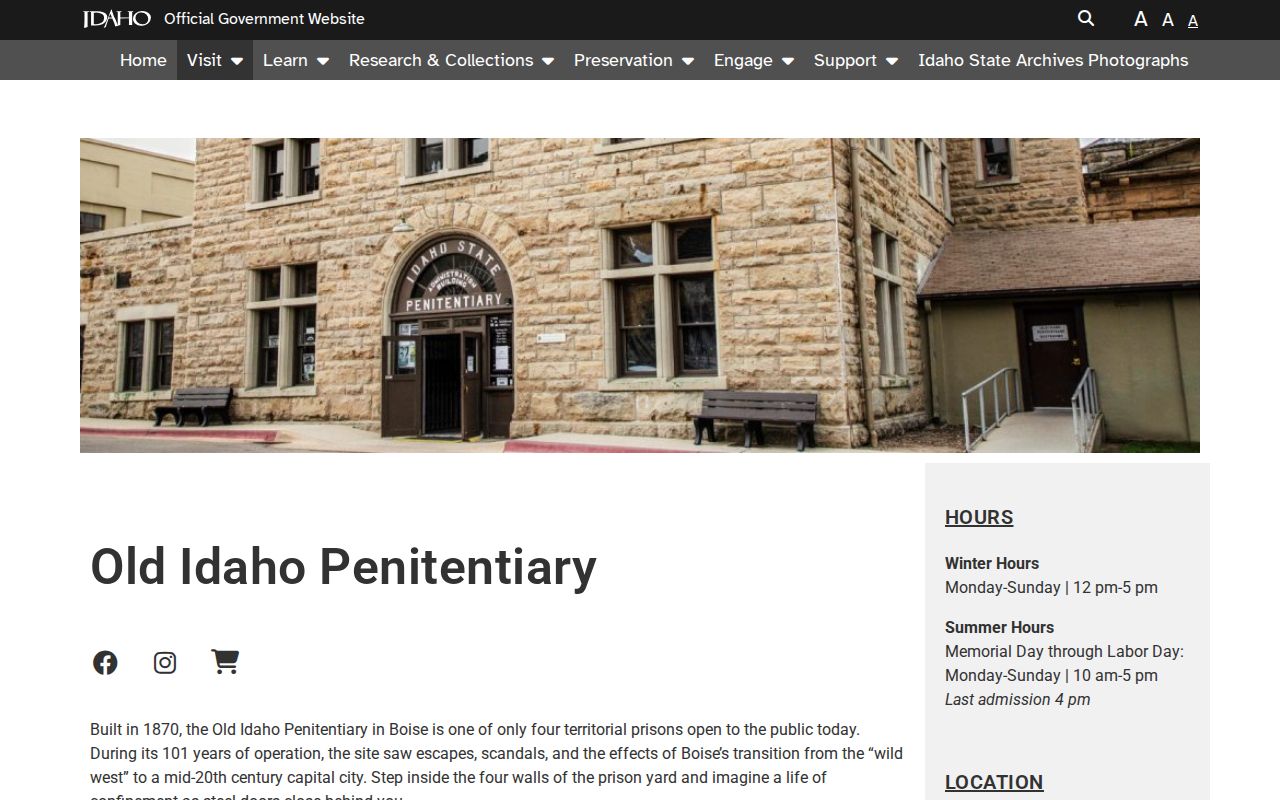
This collection covers one state prison only. It is not a county booking archive. County and city arrest records require their own agency, court, and transfer checks.
Note: Archives organize material by collection and creator, so an agency name or record group can matter as much as a person's name.
Idaho Penitentiary Photo Records
The oldest statewide photo lead is the Idaho Penitentiary collection. The prison ran from 1872 to December 1973. Its files are institutional custody records, not a register of every Idaho arrest. Digitized and indexed penitentiary material covers territorial and state inmates from roughly 1864 to 1947. That span and the prison's operating dates describe different things. Early territorial material predates the later state prison. Later resident files may need their own catalog search.
Other collections can preserve a trace of an arrest without holding the original mugshot. The State Archives keeps county and city government records. Law-enforcement files, historical photographs, and newspapers are part of the holdings. Court material sits there too, where it was transferred or microfilmed. The chart sorts these leads by custodian. Local dates depend on the agency and its transfer history. Treat a broad category as a starting point only. It cannot prove a specific file exists.
| Collection | Where it may be held | Era | How to search |
|---|---|---|---|
| Penitentiary resident files | Idaho State Archives, including Old Idaho Penitentiary material | Institution operated 1872 to December 1973; files vary | Check the Old Idaho Penitentiary FAQ, inmate index, and catalog |
| Territorial and state inmate index | Idaho State Archives searchable indexes | Indexed penitentiary material about 1864 to 1947 | Search the index, then request the listed file or image reference |
| Sheriff, police, jail, and county records | Creating county or municipal agency; Archives if transferred | Agency and transfer dates vary | Ask the records custodian whether the item remains local or moved |
| Filed case and disposition | County court clerk, Idaho court search, or transferred court collection | Case and access vary | Search iCourt, contact the clerk, and check Archives descriptions for older material |
| Historical news coverage | Newspaper archive or library microfilm | Publication run varies | Search a date and place; label a newspaper image as press material |
The Archives offers searchable indexes and a catalog for collection-level and item-level discovery. Its catalog search instructions can refine terms. A name search sometimes returns too much. Sometimes it returns too little. An index is a finding aid. It is not the record itself. Catalog entries may use an agency or collection name, not a person's.
How Idaho Record Retention Works
Retention schedules give leads, not answers. No schedule can confirm that one photograph survived. The Idaho Association of Counties law-enforcement schedule treats arrest mugshots as permanent, with a 10-year minimum. Inmate arrest records are semi-permanent for five years after incarceration. Inmate housing records are kept five years past the end of the year. Police report photographs are permanent or indefinite. Those labels describe schedule categories only. They do not guarantee that every county uses the same system, that each image was retained, or that a public website will keep displaying it.
Counties also run on local procedures. Idaho Code §31-871 governs classification and disposal review for county records. Section 31-871A covers digital reproductions and paper duplicates. Ask the agency to name the record series, its retention authority, and any transfer or disposition action. If the answer is destruction, request the basis. If the answer is a transfer, ask where. Get the destination, collection name, or accession number. That detail lets an archivist search the right group.
Online visibility is its own question. A jail roster can vanish after release, a vendor page may stop loading, and an old county site can be replaced even while the local record survives. The Idaho law-enforcement records book is a benchmark to raise with the custodian, not proof of any particular file's status.
Note: Treat every retention period as a category-level guide, then ask the actual record holder what happened to the named file.
Requesting Idaho Historical Records
Old arrests leave two paper trails. The agency that made the arrest holds one; the court holds the other. Ask each about the booking photo and the case file. A custodian may say records moved or predate local retention. Take that answer straight to the Archives. A narrow request works better than a blanket demand. Name the date, person, and place that pin down the event. Also ask where the image sits. Is it in the booking file, a report exhibit, or some other record series?
- Set the search range. Write down the person's full name and known spelling variants, approximate year or date range, arresting city or county, and any known booking or court number. If custody may have occurred in a neighboring county, name that possibility too.
- Ask the original agency. Send a request to the sheriff, jail, or municipal police records custodian that handled the event. Identify the booking record and photo sought, ask whether they remain in agency custody, and request the retention or transfer reference if they do not.
- Check the court track. Search the Idaho iCourt Portal for a filed case, then contact the county clerk for a case record or disposition that is not available online. A case file can help confirm the event and outcome, but it is not the same record as the jail's photograph.
- Search Archives finding aids. Use the Idaho State Archives indexes and catalog. Try the person, county, town, agency, and likely record series, including terms such as sheriff, municipal police, jail register, booking record, and arrest photograph.
- Ask for a collection search. If a likely collection appears, send the Archives the name, county, years, collection or folder reference, and the precise item sought. Ask whether a photograph is digitized and what reproduction options, charges, and timing apply to that collection.
The Attorney General's public-records guidance walks through the Idaho Public Records Act and how a request works. Idaho leans toward disclosure. Still, each request turns on one specific record. Facts of an arrest can be public under §74-102. Juvenile files, protected victim or medical details, and some active-investigation content may stay withheld or redacted. When a record mixes public and protected material, ask for the segregable portions. Every local office picks its own request channel. Fees and turnaround vary with the collection, so confirm costs before ordering copies.
Recent Records Need a Different Route
A recent arrest rarely lives in a historical catalog. The current county or city agency is the better starting point. Check the arresting agency's roster, booking feed, or records unit, then look at the court docket for the filed case and its outcome. Idaho has no single statewide booking-photo database. Local systems vary widely. Some counties post photos. Others show text or a PDF. A few publish no roster at all. An image missing online does not mean no booking photo was taken or kept. The Idaho County Directory links to county systems. The statewide Idaho booking and mugshot search overview ties rosters, request paths, court records, state custody, and federal custody together. A roster is a short-term custody view. A docket tracks the case, while an archive keeps what was transferred under separate rules. For older matters, ask the agency first, then try the Archives.
Note: The arresting agency, booking location, court venue, and later archive may point to different Idaho counties.
When Relief Changes Idaho Mugshot Access
Idaho offers more than one form of record relief. Each reaches a different system. Under §67-3004(10), Idaho State Police can expunge an eligible fingerprint and criminal-history record in listed situations, such as no charging instrument within a year, an acquittal, or a dismissal, with a withheld-judgment exception noted in the statute. The ISP Bureau of Criminal Identification explains the process and posts an application. That state action does not force counties to drop separately held booking photos. The Clean Slate Act works differently. Section §67-3004(11) lets a qualifying person petition to shield certain records from public view. Five years must pass after sentence completion and all conditions. The Idaho Supreme Court's Clean Slate Act information and petition instructions spell out eligibility and filing. Shielding restricts public court access; it does not destroy the case. Courts and authorized justice officials keep access under the governing rules. Neither process erases every copy online. A sheriff's record, a court file, a newspaper story, an archive scan, and a private publisher page are separate records. Each has its own custodian. Once an order or agency confirmation is in hand, send a correction request to every holder. Identify the exact URL, booking or case number, and outcome document. Search engines add one more layer. An index may still point to a changed page. Relief changes public access. It cannot make every old copy vanish.