
Idaho's Public Fugitive Lists
No single Idaho page gathers every wanted person, county warrant, and jail booking. The closest statewide public source is the Fugitive Recovery page run by the Idaho Department of Correction. Its Special Investigations Unit handles fugitive recovery alongside partner agencies. Profiles there involve people sought over IDOC supervision, chiefly probation or parole absconders. That is a supervision status. It is not a new county booking.
The U.S. Marshals Service District of Idaho, with its Greater Idaho Fugitive Task Force, posts selected notices when a case needs the public's help. Those are case notices. They are not a full federal roster. Idaho State Police alerts fill a different public-safety role. A sheriff's office is still the local warrant source, and the ISP alert page is no statewide wanted list.
Which Idaho Wanted List Fits?
Begin with the right agency and the exact status you need. A wanted poster shows only a face and a name. Courts can tell you more than any notice will. Someone absent from one list may still hold a warrant or open case somewhere else.
| Source | What It Covers | Photos and Access |
|---|---|---|
| IDOC Fugitive Recovery | People sought in connection with IDOC supervision, including probation or parole absconders. | Profiles may show an image or identifying feature image. Check the official profile for its current status. |
| U.S. Marshals, District of Idaho | Selected federal fugitive notices and public requests for help. | Notice-specific. Read the agency's own notice; there is no county-style national photo roster. |
| Idaho State Police Missing Persons & Alerts | Public safety alerts, including missing-person notices, rather than a complete warrant list. | Alert-specific information appears on the ISP page. It is not a public booking-photo feed. |
| County sheriff sources | Local warrant information or agency notices, where a county publishes them. | Coverage and format vary. Use the Idaho county directory to reach the proper local source. |
Each source answers a different question. IDOC tracks people who left supervision, USMS notices cover certain federal cases, ISP alerts share public-safety warnings, and a sheriff's list handles local matters. Go to the agency that owns the record.
Note: A public alert or IDOC supervision notice is not a complete Idaho county warrant list or jail roster.
Idaho IDOC Supervision Fugitive List
The IDOC Fugitive Recovery list is the state's public absconder source. “Absconder” means a person IDOC says has left or failed to follow the terms of supervision. The page describes an investigative unit that works with other law-enforcement agencies. It does not label every person on the list as newly arrested, held in a county jail, or convicted of a new offense.
That distinction matters when a name appears in several systems. A person may have an older court case, a supervision warrant, or a later arrest record, and each record answers a different question. IDOC's “at large” or “captured” status describes its fugitive-recovery listing. It does not replace a current county custody check or a court search for the case's outcome.
Open the official IDOC Fugitive Recovery page for the live list. No fixed posting schedule is stated, so check the date and status shown on the live profile rather than assuming a regular update cycle.
Fields in an Idaho Wanted Listing
An IDOC profile packs in several useful fields. Expect a name, a photo, identifying details, and the person's supervision status. A name match alone proves little, since shared names are common. Open the whole official profile. Keep its supervision context in mind.
| Profile Field | What It Tells You |
|---|---|
| Name and IDOC number | The listed person's name and the department's identifying number. |
| Physical descriptors | Traits the agency provides to help distinguish the listed person. |
| At large or captured status | The status shown on the fugitive-recovery profile when viewed. |
| Wanted date | A date associated with the agency's wanted entry. It is not necessarily the date of a new arrest. |
| Warrant description | The warrant information associated with the supervision listing. |
| Image | A mug-style or other identifying image may appear. It remains on IDOC's page and may not be a county booking photo. |
A wanted notice pairs a photo with the details an agency needs help with. The picture aids identification. Nothing more. Do not pull it into some unrelated mugshot gallery. These images belong with their official listings, so treat them as part of the record. When a field looks stale or confusing, use the contact route printed on the agency page.
Note: A supervision listing, a county booking, and a court disposition answer three different questions about one person's record.
Idaho's Selected U.S. Marshals Notices
Federal fugitive work in Idaho runs through the U.S. Marshals Service District of Idaho. The district posts public-assistance requests when investigators need tips on a specific case. One example is the Greater Idaho Fugitive Task Force notice. It shows that case-by-case method clearly. These notices are chosen for release. They are not a full list of federal warrants, nor a roster of everyone in federal custody.
Read each notice on its own terms. The USMS page states what help it wants and how to make contact. A notice may carry an image or identifying details, but the district site remains the authority on current status. The issuing court controls the warrant and the case record behind it.
Federal pretrial custody is its own thing. It is not an IDOC supervision listing. It is not a county booking either. For Idaho arrest photos, booking details, or release questions, start with the Idaho busted mugshots and records page.
Idaho ISP Alerts and Warrant Lists
The Idaho State Police Missing Persons & Alerts page posts public safety notices for the state. It is worth checking. But it is not a statewide arrest roster. Nor does it offer a searchable list of every active warrant. Alerts are often time-sensitive. Read each one on the official ISP page, which carries its own instructions.
Behind the scenes, ISP runs ILETS, a network linking authorized agencies to national wanted and missing-person files. That system is closed to the public. It creates no open mugshot database. For a statewide warrant question, residents still need the court portal or a sheriff's own records. These systems answer different questions. An alert communicates a safety notice. A sheriff roster reports local custody, while a court docket tracks case activity. One person can appear in several systems with different purposes and statuses.
Idaho County Sheriff Warrant Sources
Idaho's county sheriffs handle wanted notices their own way. There is no uniform statewide format. Some counties post a wanted page or local notice, while others point people toward court records or a direct agency contact. A county roster is mostly a custody snapshot. It rarely answers whether a warrant is active or how an old case ended.
Start with the county where the case was filed. The Idaho County Directory links to each county site. Follow that agency's instructions, then turn to iCourt when a name or case-number search is available. Think the person may be in custody now? Confirm through the county jail's official roster or records office rather than a statewide fugitive notice.
County pages go stale. Some omit sealed matters entirely. A name missing from a local list proves nothing about whether a warrant exists. Court access rules, warrant type, and service status all shape what the public can see.
Note: County wanted notices vary, so use the county source for local instructions and iCourt for the public case record.
Using Idaho's Wanted Lists Safely
A wanted notice is a lead to an official agency. It is not permission to investigate someone yourself. The source page names the issuing agency. It also explains the help it wants. Read that context before trusting any name, image, or status you find.
- Choose the right source. Use IDOC for an IDOC supervision fugitive, a USMS notice for a selected federal case, and a county sheriff source for local information.
- Open the official profile. Compare the name with the agency number, physical descriptors, status, and any case or warrant description shown.
- Check the status on the live page. The profile may change. Do not rely on a copied image, old social post, or third-party repost as the current record.
- Send a tip through the listed agency. Share only information you lawfully know. Do not approach, follow, confront, or try to detain the person.
Call 911 for an immediate threat. The statewide IDOC page takes anonymous web tips, lists phone channels, and warns people not to approach a fugitive. Send a tip to law enforcement, never to a comment thread.
Check an Idaho Court Warrant
A curated wanted list is not a warrant search. For a specific case, start at the Idaho iCourt Portal. It is the statewide public route to trial-court cases, hearings, payments, and register-of-actions details. Search by name, county, or case number. The register of actions is the court's running case history. Filings, hearings, and later events all appear there.
Once the public search turns up the right case, read its docket. Then read any available documents. Compare more than a name before calling a result a match. The portal's warrant view has limits. An empty result does not promise that no warrant exists. When online details fall short, turn to Idaho Supreme Court guidance. It explains how to view case records. It also covers requesting copies from the proper clerk.
- Search the public portal. Enter a name and narrow by county or case number when known. Review results for the right court case.
- Open the case record. Read the register of actions and any public filings that explain the current case or warrant entry.
- Note access limits. Bench-warrant existence is generally public, while an unreturned arrest or search warrant may be sealed or restricted until service.
- Use the clerk for the next record step. Ask about the public record route when online information is incomplete. Sealed material remains subject to access limits.
The official iCourt warrant tutorial explains the portal's warrant search, its limits, and which public fields appear. The court's public-search tutorial shows the wider path. Neither displays a case result or photo.
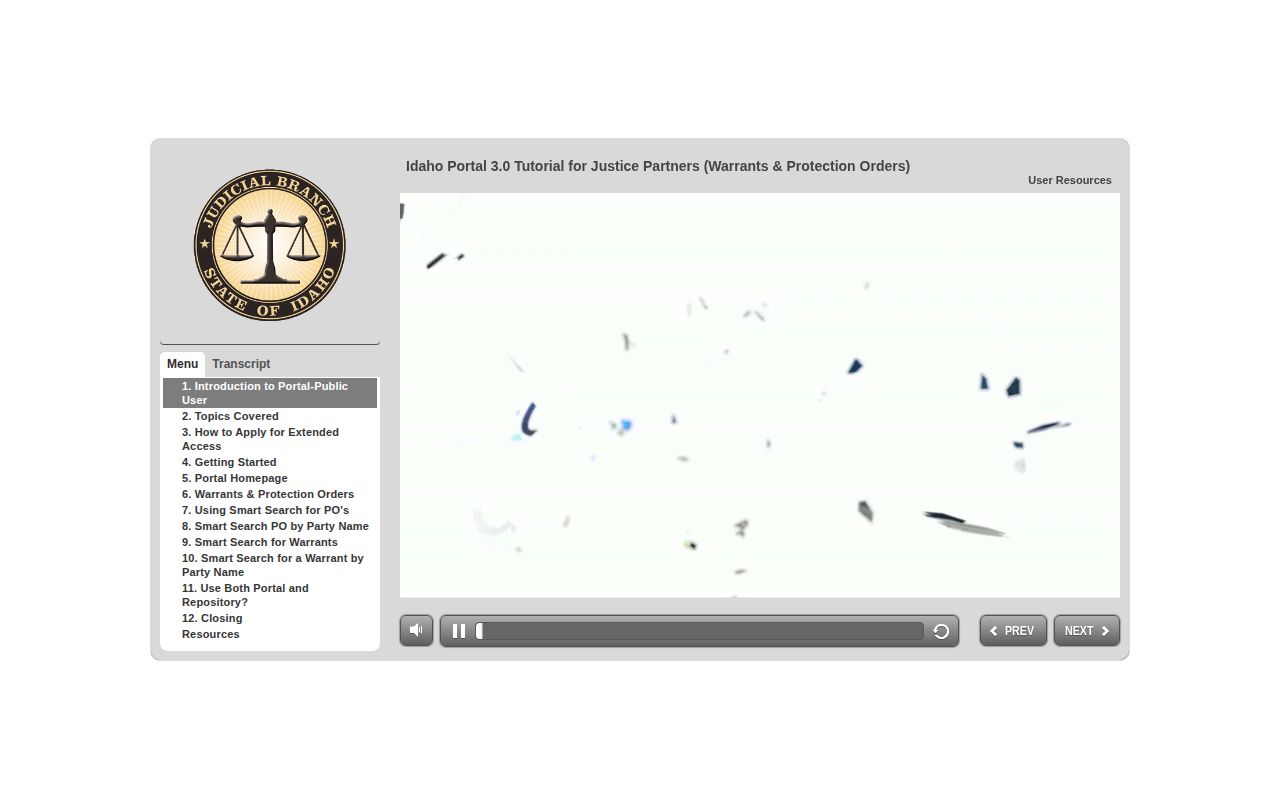
Portal access varies. Sealed status, warrant type, and the user's access level all shape what appears. County transitions add a wrinkle. A statewide search may require both Portal and Repository. The court's current instructions say so.
Note: The court tutorial explains public warrant fields, but seals and access rules still shape each result.
Idaho Warrant Types and Limits
"Warrant" covers several court-authorized actions. The type matters. The public portal does not expose every warrant the same way, and Idaho's court tutorial separates public bench-warrant information from unreturned arrest and search warrants that stay sealed or restricted until service.
| Type | Plain Meaning | Public Search Limit |
|---|---|---|
| Bench warrant | A court order to bring a person before the court, often after a missed appearance or failure to follow a court order. | Existence is generally public, though the case record still controls what details are available. |
| Unreturned arrest warrant | An arrest warrant that has not yet been served and returned to the court. | It may be sealed or restricted until service, so a public search can omit it. |
| Unreturned search warrant | A warrant to search a place or property that has not yet been served and returned to court. | It may be sealed or restricted until service; it is different from a person's arrest status. |
Idaho's access rules still apply here. One is ICAR 32. It works with a case's sealed or restricted status, so read any result as the public record on hand rather than a complete view of every court or law-enforcement file.
Idaho Warrant Search Gaps
Searches can come up empty for innocent reasons. Some warrants stay sealed until they are served. Others hide behind a misspelled name. A case filed in one county might sit in another system entirely. Idaho's statewide court guidance acknowledges this, noting that both the Portal and the Repository may be needed while a county transition is underway. So a blank result is rarely the last word.
The Idaho Supreme Court's records and access page lays out the official routes. Searchers can look up general case information online. Courthouse kiosks let visitors view records in person. The clerk handles requests for copies of case files. When the online docket looks thin, use these channels instead of assuming nothing exists. Sealed material, though, still carries its access limits.
Keep custody and court data separate in your mind. iCourt follows court cases. A county jail roster shows who is in local custody at one moment. IDOC's fugitive listing tracks people who walked away from supervision. One source can be silent while another holds the answer you need.
Note: A clean name search cannot rule out a sealed or unreturned warrant, and a roster cannot show the full court outcome.
Send an Idaho Fugitive Tip Safely
Send tips to the agency that issued the notice. IDOC runs an anonymous web-tip form plus phone lines, including 208-658-2167. The department also points to statewide Crime Stoppers options. Whatever method the live notice shows, use it, so your tip lands with the right team.
- Use the agency's own route. For an IDOC listing, open the IDOC anonymous web-tip form or use the phone channel shown by IDOC.
- Share what you lawfully know. Give clear facts that may help the agency assess the tip. Do not trespass, track a phone, access private accounts, or seek more details by confronting anyone.
- Keep the tip private. Do not post a person's location or personal details online. Let investigators assess the information and decide what action is safe.
IDOC Fugitive Recovery Tips
Use IDOC's anonymous web-tip form, or call 208-658-2167; statewide Crime Stoppers options are also listed by IDOC. Call 911 for immediate threats. Never approach, follow, or detain anyone.
A warrant touching you or a family member needs a lawyer or the court. Don't try to settle it through a listed person. A social media post is no basis for legal steps.